E-invoicing
Slovak e-invoicing from 2027: the complete guide to mandatory eFaktúra
From 1 January 2027 Slovak VAT payers must send invoices as XML through a certified Peppol access point. Who issues, who receives, exceptions, deadlines, penalties and a checklist.
In short
- From 1 January 2027, VAT payers established in Slovakia must issue invoices to other Slovak businesses as structured XML (Peppol BIS 3.0) and send them through a certified access point, the “digitálny poštár”.
- Every Slovak business must be able to receive e-invoices, including those not registered for VAT. Nothing changes for consumers.
- A PDF is no longer the invoice, only a readable copy. VAT payers keep e-invoices as XML for 10 years.
- Exceptions: documents up to €100 incl. VAT and eKasa till receipts up to €400 incl. VAT. From 1 July 2030 the mandate extends to cross-border supplies.
- As of 28 October 2026 the date is not postponed. Parliament is debating an amendment with a penalty-free grace period until 30 June 2027; it is not law yet.
Electronic invoicing is no longer optional in Slovakia. Act No. 385/2025 Coll., which amends the VAT Act and transposes the EU’s VAT in the Digital Age (ViDA) directive, makes e-invoices mandatory for domestic business-to-business sales from 1 January 2027. Almost every business in Slovakia is affected: some must issue e-invoices, all the others must be able to receive them.
Find out in 30 seconds whether it applies to you with our check. This guide covers what changes, who it applies to, which documents stay as they are and what to prepare before the end of 2026. It is based on the Act, the Slovak Financial Administration’s manual and its official Q&A (sources at the end).
What an e-invoice is
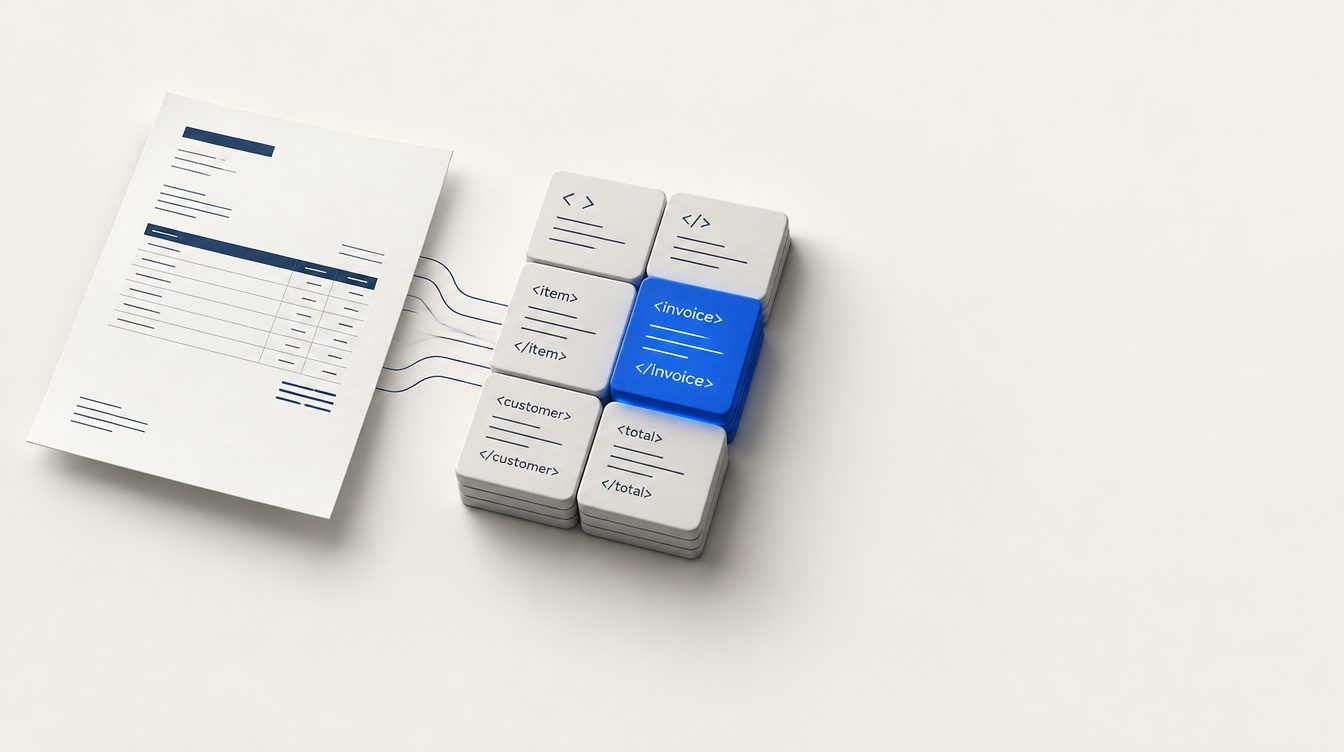
An e-invoice (eFaktúra) is an invoice in a structured XML format that complies with the European standard EN 16931. Slovakia uses Peppol BIS Billing 3.0 with Slovak validation rules (UBL 2.1 or CII syntax). Accounting software can load it without retyping because every value has its exact place in the file.
A PDF, a scan or an image e-mailed as an invoice is not an e-invoice. A PDF may travel with the XML as an attachment or readable view, but from 2027 only the XML counts as the invoice.
Timeline
| Period | What applies |
|---|---|
| 2026 | Voluntary. A VAT payer may send an e-invoice through an access point without the buyer’s consent if the buyer is reachable on Peppol. |
| from 1 Jan 2027 | E-invoices mandatory for domestic supplies between Slovak businesses and to the public sector (B2B and B2G), under the transitional regime of §85o of the VAT Act. |
| 1 Jan 2027 – 30 Jun 2030 | Transitional period: the duty covers VAT payers established in Slovakia and domestic supplies. |
| from 1 Jul 2030 | All taxable persons and intra-EU cross-border supplies. The invoicing deadline shortens from 15 to 10 days; the VAT control statement and the EC sales list are abolished. |
What matters is the date the obligation to issue the invoice arose, not the due date or the payment date. If it arose on or before 31 December 2026, the 2026 rules still apply.
Who is affected
Who must issue and send e-invoices
VAT payers established in Slovakia, for supplies of goods or services to another Slovak taxable person or a Slovak legal person. Until 30 June 2030 the duty does not apply to foreign businesses registered for Slovak VAT.
Who must be able to receive them
Every domestic business, including those not registered for VAT: sole traders, liberal professions, farmers and private landlords. Non-business legal persons such as municipalities, non-profits and associations must also be able to receive. Each business is responsible for its own readiness. See e-invoicing for non-VAT payers.
Who is not affected
Consumers (B2C). A business that is not a VAT payer never has to issue an XML e-invoice, and a buyer cannot demand one. An invoice from a foreign supplier does not have to arrive via Peppol.
Delivery: the “digitálny poštár”
E-invoices travel through a digitálny poštár (“digital postman”), a Peppol access point certified by the Financial Administration (§76a of the VAT Act). You choose your provider; the list of certified providers is published at vpds.financnasprava.sk. Many invoicing and accounting products include one, directly or through a partner.
Your identifier on the network is your tax number (DIČ); no new registration number is needed. Sending the XML by e-mail or EDI is allowed only with the buyer’s prior consent, and the XML format remains mandatory. Even then, every business needs an access point at least for receiving.
Deadlines and reporting
The invoice must be issued within 15 days of the supply (§73) and, within the same 15 days, sent or made available to the buyer. Creating it in your system is not enough.
For invoices sent through an access point, the access point passes the data to the Financial Administration automatically. Under the current wording the supplier reports on issue and the buyer within 5 days of receipt. Invoices sent by e-mail with consent carry no reporting duty, but they stay in the VAT control statement.
Exceptions: when no e-invoice is needed
- Simplified invoices up to €100 incl. VAT (§74(3)(a)).
- eKasa till receipts up to €400 incl. VAT, and receipts from unattended fuel pumps paid electronically up to €400. See eKasa receipts and VAT deduction.
- VAT-exempt supplies under §§28–43 and §47.
- Supplies to the Slovak intelligence services.
- Pro-forma invoices that are not tax documents are not sent through the system.
Two more changes: the old €5,000 threshold of Act No. 215/2019 Coll. on e-invoicing to the public sector disappears, so the mandate applies to any amount. And an instalment schedule can no longer serve as a summary invoice.
Archiving
VAT payers must keep e-invoices in their original XML format for 10 years from the end of the year they relate to (§85o(15)). A printed PDF or a scan does not satisfy this. The VAT Act imposes no such duty on non-VAT payers receiving e-invoices, but the Accounting Act periods still apply. See how long to keep invoices and receipts.
Penalties
According to the Financial Administration’s manual, failing to report data, or reporting it incorrectly or late, can cost up to €10,000 per breach and up to €100,000 if repeated. Not issuing an e-invoice is an administrative offence under the Tax Procedure Code. No penalty applies to an obvious error corrected promptly, or to a proven outage of the access point.
What changes for the invoices you receive
The debate focuses on issuing, but for most companies the bigger change is on the cost side. From 2027 most invoices from Slovak VAT payers arrive as XML in your access point’s inbox. They still have to get into your books, be checked, matched to payments and archived as XML.
Paper and PDFs won’t disappear, though: till receipts up to €400, invoices from non-VAT payers, from foreign and Czech suppliers, 2026 documents and invoices sent outside Peppol all remain. That is why the Financial Administration’s manual advises asking your software vendor whether received e-invoices load without retyping and get matched with payments. We cover the practice in received e-invoices in your accounting.
Checklist for 31 December 2026
- Check whether you are a VAT payer. If you are, you will issue and receive e-invoices; if not, only receive.
- Ask your invoicing software vendor whether it produces Peppol BIS 3.0 XML and which access point it uses.
- Choose an access point from the Financial Administration’s list and register for receiving, even if you don’t issue invoices.
- Check your customers’ data: tax number, VAT number, address. Buyers find you on the network by your tax number.
- Decide where received e-invoices go, who checks them and how they reach your books.
- Set up 10-year XML archiving.
- Agree with your accountant how you’ll hand over documents that stay in PDF or on paper.
- Test it in 2026: the voluntary period is the best time to find problems.
Frequently asked questions
Is the 1 January 2027 deadline postponed?
No. The pending amendment only proposes a penalty-free grace period until 30 June 2027 for late issuing and some reporting errors. The duty applies from 1 January 2027, and as of 28 October 2026 the amendment has not been passed.
Do I need an access point if I am not a VAT payer?
Yes, if you do business in Slovakia. From 2027 you must be able to receive e-invoices. You don’t have to issue them.
Is a PDF invoice still valid from 2027?
Between two Slovak businesses where the supplier is a VAT payer, no: the invoice is the XML delivered through the access point and the PDF is only a readable copy. PDFs remain common for non-VAT payers, foreign suppliers and the exceptions.
Does e-invoicing apply to till receipts?
An eKasa receipt up to €400 incl. VAT counts as a simplified invoice, so no e-invoice is needed. Above €400 a VAT payer must issue an e-invoice to a business buyer.
How long must I keep e-invoices?
VAT payers keep them for 10 years from the end of the year they relate to, in the original XML format.
Sources
- Finančná správa SR: e-Faktúra (stránka k povinnej elektronickej fakturácii)
- Finančná správa SR: Manuál k elektronickej fakturácii pre podnikateľov (26. 8. 2026)
- Finančná správa SR: Otázky a odpovede k e-faktúre, informácia 9/DPH/2025/IM (aktualizácia 27. 10. 2026)
- Zoznam certifikovaných digitálnych poštárov (VPDS, Finančná správa SR)
- Slovenská komora daňových poradcov: novela zákona o DPH (zákon č. 385/2025 Z. z.)
- Zákon č. 222/2004 Z. z. o dani z pridanej hodnoty (konsolidované znenie)
- Smernica Rady (EÚ) 2025/516 (DPH v digitálnej ére, ViDA)
- Podnikajte.sk: Zmeny v eFaktúre, štát ju opravuje pred zavedením